

CRM Data Integration in Marketing: A Way to Make Lead-Based Advertising More Effective

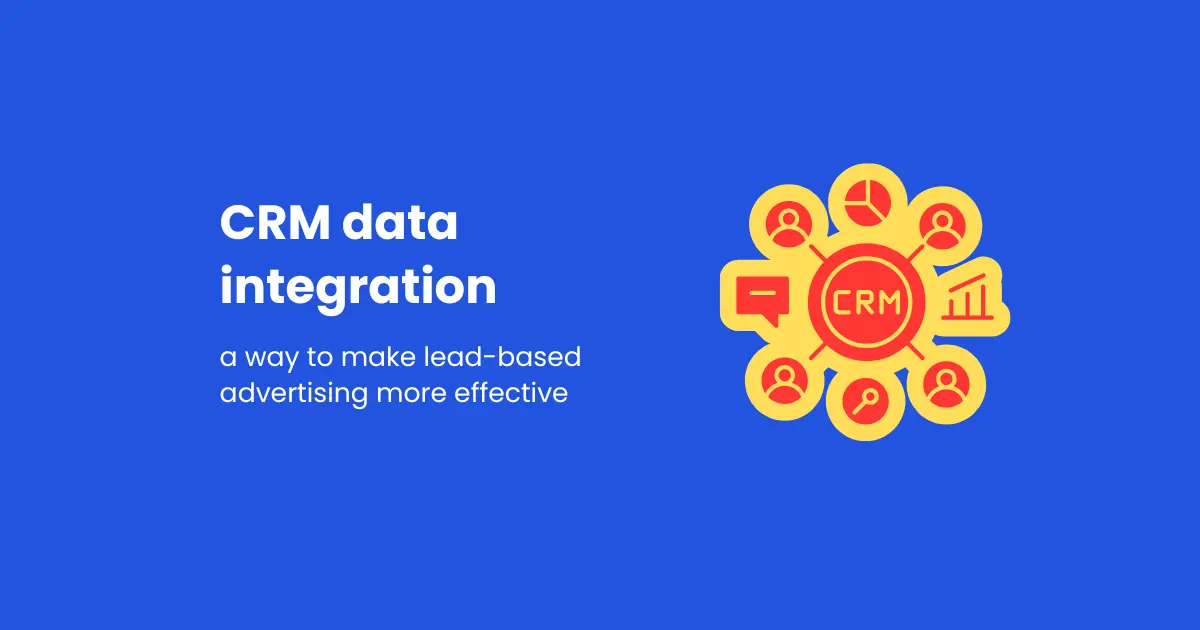
In this article, we explain in detail what CRM data integration in marketing is, how it works in practice, and the role it plays in modern data-driven marketing. We also explore the real value that CRM data and CRM integration create for businesses—from more precise audience segmentation and personalized communication to more efficient use of advertising budgets and increased sales growth.
As in e-commerce, digital advertising is one of the most important channels for business and sales growth, as well as customer acquisition in the medical services, clinics, construction firms, custom product creators, and B2B service provider sectors. Many companies invest in campaigns across Google Ads, Meta, and other advertising platforms with the goal of generating as many inquiries as possible at the lowest possible cost. However, in practice, a paradoxical situation is becoming increasingly common: the number of inquiries grows, but the increase in actual sales does not match expectations or investment levels.
In most cases, the issue lies not in the advertising platforms or creative execution, but in the lack of data. Advertising systems’ artificial intelligence optimizes campaigns based on clicks, inquiries, and other events or criteria, but it does not see the true business reality— which leads turn into sales, which customers generate the highest value, or which channels actually drive real revenue versus those that bring low-quality or irrelevant inquiries.
This is exactly where a critical gap emerges—one that must be addressed to unlock the full potential of advertising platforms. Recognizing this problem, we analyzed the situation and realized that businesses need to turn to their CRM systems, which store the most accurate and valuable data about customers, their status, and their actions. This led us to develop a technological solution we call: CRM data integration in marketing into artificial intelligence. Through this approach, CRM data is seamlessly integrated into advertising platforms and analytics systems, transforming traditional inquiry-based advertising into a data-driven system that effectively generates sales.
In this article, you will learn:
- Why lead-based advertising often doesn’t perform as expected
- CRM data integration in marketing into artificial intelligence: what it is and how CRM data and its integration in marketing actually work
- How CRM data transforms advertising performance
- What the different levels of CRM integration in digital marketing are
- How CRM data integration in marketing into artificial intelligence enables advertising algorithms to “learn”
- How CRM data integration in marketing increases advertising effectiveness
Why does lead-based advertising often not perform as expected?
Many businesses in digital marketing still rely on a relatively simple and widely used model, where the primary goal of marketing is to generate as many inquiries (leads) as possible. In this case, the effectiveness of advertising campaigns is measured by how many users complete a specific action on a website. Most commonly, these conversions include:
- website form submissions;
- phone calls;
- registrations for consultations or product demos;
- general contact inquiries.
Based on these signals, advertising platforms such as Google Ads, Meta, TikTok, LinkedIn, Snapchat, Pinterest, and others optimize campaigns. Their algorithms analyze user behavior and identify people who are most likely to complete one of these actions, then show them ads. At first glance, this seems like a logical strategy—the more inquiries generated, the higher the chance that some of them will convert into customers.
However, in practice, this approach has a fundamental flaw—an inquiry is not a sale. In other words, the artificial intelligence behind advertising platforms optimizes campaigns based on an action that does not necessarily create real business value.
Advertising algorithms are essentially trained to generate as many conversions as possible, but they lack visibility into what happens after an inquiry is submitted. They do not know whether the sales team contacted the lead, whether the prospect had a real need, or whether a deal was actually closed. As a result, advertising systems cannot distinguish between high-quality, valuable leads and those that represent only superficial interest.
Because of this, campaigns often start attracting a large number of contacts who are not truly qualified potential customers. These may include users who:
- are only seeking information but have no real intent to buy;
- do not have sufficient budget for the product or service;
- do not belong to the target customer segment;
- are only comparing prices or looking for general information;
- submit fake or “spam” inquiries, including bots; misunderstood your product or offer;
- initially thought the product or service was relevant, but later realized it is not suitable;
- and many other reasons why a sale will not be completed.
From the perspective of advertising platforms, such users are still considered successful conversions because they completed the desired action. However, from a business perspective, these inquiries often carry little to no real value. This is where companies face several significant challenges.
First, advertising budgets are used inefficiently, as a portion of the investment is allocated to audiences with a low likelihood of becoming customers. As a result, the cost of acquiring high-quality leads increases to a level where advertising can no longer generate profitable sales.
In many cases, organizations simply stop advertising on Google Ads, Meta, or other platforms, making a strict—but often incorrect—judgment that advertising does not work for them and is not worth the investment. This is one of the worst possible outcomes, as businesses may close the door to one of the most important growth opportunities for a long time. Misguided assumptions can even lead to business failure, while the real issue usually lies elsewhere—in poor strategy, incorrectly chosen tools, or the inability to properly analyze and find the right solution.
Second, sales teams are forced to spend a significant amount of time handling low-quality inquiries, which reduces the overall efficiency of the sales process and team productivity, ultimately increasing organizational costs.
Third, marketing results become difficult to predict, as the number of inquiries no longer reflects actual business growth or revenue.
For this reason, more and more organizations are starting to rethink their approach to digital marketing. Instead of optimizing campaigns solely based on the volume of inquiries, the focus is shifting toward real business value—actual customers and revenue. By integrating CRM systems into the advertising process, businesses can connect marketing and sales data, enabling advertising platforms to optimize campaigns based on what truly generates revenue. In other words, platforms can identify users whose behavior on Meta, Google, YouTube, or other platforms is similar to those who have already purchased from you. Their behavior signals interest and a higher likelihood of conversion. As a result, platforms can deliver ads specifically to these high-potential users. At the same time, AI systems can adapt ad creatives and messaging dynamically, personalizing them for each individual user.
What is CRM data integration in marketing?
CRM data integration in marketing into artificial intelligence refers to the process of connecting customer and sales data from a CRM system with advertising and analytics platforms, so that campaigns are optimized not only based on user inquiries, but also on real business outcomes. This allows advertising algorithms to “see” far beyond surface-level interactions with ads or websites. Instead, they begin to analyze the entire customer journey—from the first ad click to the actual sale, or even the long-term value of a customer to the business.
CRM systems are one of the most important data sources within an organization, as they store detailed information about customer relationships. They capture not only the initial inquiry, but also the subsequent stages of the sales process. Among the most important types of data that can be used for marketing optimization are:
- received inquiries and their sources;
- customer statuses in the sales process (new contact, marketing-qualified lead, sales-qualified lead, won deal, lost deal);
- deal revenue, products sold, and their quantities;
- customer lifetime value (LTV – Lifetime Value).
CRM data provides artificial intelligence systems with a much deeper understanding of which potential customers are truly valuable to a business and which only generate superficial interest. During integration, this information can be shared with advertising platforms such as Google Ads, Meta Ads, TikTok Ads, or LinkedIn Ads. As a result, advertising algorithms receive additional signals that enable them to more accurately identify users on their platforms who are most likely to become real customers, as well as to better understand which behavioral patterns, interests, or search signals are most often associated with successful conversions.
When advertising systems begin to learn from real business data, the logic behind campaign optimization also changes. Instead of focusing on generating as many inquiries as possible, campaigns shift toward revenue generation and increasing profitability (ROAS). This means that advertising algorithms start seeking users who are not only likely to fill out a form or leave their contact details, but who also have the highest probability of becoming paying customers.
Over time, this approach allows advertising platforms to operate much more efficiently. They begin to reduce the number of low-quality inquiries and allocate budgets more accurately. As a result, advertising evolves from a simple lead-generation channel into a strategic tool that directly contributes to business revenue growth.
You can learn more about CRM integration in marketing here: CRM data integration in marketing into artificial intelligence.
How does CRM data change advertising effectiveness?
By integrating CRM data into advertising systems, businesses gain the ability to analyze and optimize marketing on an entirely different level. Instead of making decisions based solely on surface-level signals, advertising platforms begin leveraging real business data about customers, sales, and deal value. This enables optimization across different areas of marketing based on what truly drives business growth. This approach unlocks several key opportunities:
1. CRM data and high-value customer identification
CRM systems enable businesses to segment customers based on their economic value. This may include customers who generate the highest revenue, purchase most frequently, or have the greatest lifetime value. When CRM data is integrated with advertising platforms, algorithms begin to better understand which types of users are the most valuable.
As a result, advertising systems start looking not only for people who are likely to submit an inquiry, but also for users who behave similarly to existing high-value customers.
2. More accurate measurement of return on advertising investment (ROI)
One of the key advantages of CRM integration is the ability to accurately measure the return on investment (ROAS) of advertising and other marketing channels. This is not just a technical convenience—for many businesses, it is a critical growth driver.
Very often, the main reason businesses do not invest in effective advertising channels is not because advertising doesn’t work, but because they are unable to clearly measure its impact on sales. In other words, businesses fail to see the connection between money spent and revenue generated. As a result, advertising budgets remain stagnant and sales growth potential is left untapped—even in cases where advertising is actually profitable.
When a CRM system is integrated with analytics tools such as Google Analytics, it becomes possible to link every inquiry to real sales data based on traffic sources. Within the CRM system itself, this can even be extended to other marketing channels.
In this case, the marketing team can see not only how many inquiries advertising generates, but also:
- which ads actually led to a real sale;
- which ad was the final touchpoint through which a user contacted the sales team after visiting your website;
- what the value of the deal was; what the true customer acquisition cost is overall, or by each traffic source individually;
- what long-term value a specific customer generates (LTV).
However, even more importantly, this information allows businesses to answer a fundamental question: does advertising actually generate profit, and how much is it worth investing in it further?
In practice, this often becomes a turning point. Once the challenge of measuring advertising effectiveness is solved, there is often no need to fundamentally change the campaigns themselves—it is enough to confidently increase budgets for the channels that are already performing well. The issue is usually not the quality of advertising, but the lack of visibility into its true value.
Equally important is that these insights are understood not only by marketing specialists, but also by business leaders or owners. They are the ones making decisions about budgets and growth direction. When decision-makers clearly see how advertising translates into revenue, their mindset shifts—from cautious testing to strategic scaling.
As a result, marketing budgets can be allocated more strategically—investing in the channels and audiences that genuinely drive revenue growth, rather than relying on assumptions or fragmented data.
3. Reduction of low-quality inquiries
One of the most common challenges in digital marketing is the high volume of inquiries that ultimately do not convert into sales. When CRM data is integrated, advertising platforms can see which inquiries turn into real deals and which remain at the initial stage of interest.
This data connection allows advertising algorithms to learn from actual outcomes and optimize campaigns accordingly. In practice, this helps to:
- reduce the number of low-quality inquiries;
- optimize audience targeting more precisely;
- allocate advertising budgets more efficiently;
- lower sales costs;
- increase the productivity of the sales team.
As a result, advertising campaigns become significantly more effective. In many cases, businesses observe that campaign performance can improve by as much as 30–50%, as optimization is based on real business data rather than just initial conversions.
4. More precise audience segmentation
CRM data enables the creation of far more precise and strategic audience segments. Instead of relying on broad demographic or interest-based audiences, businesses can use real customer data and behavior.
For example, CRM data makes it possible to identify segments such as:
- existing customers;
- potential customers who have already shown interest in the product;
- “hot” leads actively searching for a solution;
- customers with the highest purchase value;
- wholesale customers;
- retail customers;
- customers who have purchased specific products;
- customers who have not yet purchased specific products.
In some cases, the behavior of wholesale and retail customers—for example, in Google search—can be identical. Both a wholesale and a retail customer searching for wooden or plastic windows may use the same queries, such as “wooden window manufacturers” or “plastic window manufacturers.” Only with additional data from CRM systems can advertising platforms distinguish which user is wholesale and which is retail. This opens up new opportunities: ad content—including messaging and copy—can be tailored and delivered to different audiences accordingly.
For a wholesale customer, you can present an offer focused on bulk supply with special partner discounts, while for a retail customer, you might offer, for example, a limited-time weekend promotion.
Such segmentation enables the creation of far more personalized advertising campaigns tailored to different user groups. Personalized communication typically leads to higher engagement, better conversion rates, and a stronger return on advertising investment.
CRM data integration in marketing into artificial intelligence and its levels
CRM data integration in marketing into artificial intelligence can take place at different levels. The more business data is available to advertising algorithms, the more accurately they can optimize campaigns and identify the most valuable potential customers. In practice, CRM integration in marketing can be divided into three main maturity levels—from basic audience imports to advanced integration of revenue and customer lifetime value (LTV) data.
Level 1 – Customer audience import
The first and simplest way to integrate CRM is by exporting customer data from a CRM system and uploading it to advertising platforms. This is typically done using customer contact information such as email addresses or phone numbers, which allow advertising systems to identify specific users.
It’s important to understand that you—and other users of platforms like Facebook or Messenger—are registered, which means platforms can identify you. If you have previously made a purchase from Company X, and that company exports your data from its CRM system and marks you as a customer, Meta’s advertising system can match you to that company and its ads.
The same principle applies to other platforms such as Google Search, YouTube, TikTok, or LinkedIn.
This type of integration typically uses:
- customer lists;
- email addresses;
- phone numbers.
CRM data is uploaded to advertising platforms and used to create custom audiences or similar audiences (lookalike audiences). This allows advertising systems to better distinguish between different user groups and plan communication more effectively.
For example, this approach makes it possible to differentiate between:
- existing customers, who can be targeted with upsell or loyalty campaigns;
- potential customers who have not yet made a purchase;
- users who have already shown interest in a product or service.
Although this is the most basic level of integration, it already enables advertising platforms to operate more precisely and reduce ad delivery to irrelevant audiences.
Level 2 – Lead quality analysis
The second level of CRM integration is significantly more advanced, as it allows advertising platforms to see what happens to a lead after it is submitted. At this stage, the CRM system begins to share information about which inquiries turn into real sales opportunities in the pipeline and which remain at the initial stage of interest.
In this case, advertising systems can receive signals about which inquiries become:
- qualified leads;
- sales opportunities;
- closed deals.
This data enables advertising algorithms to learn from actual sales process outcomes. While at the first level of integration systems target users who might be interested in purchasing, this more advanced approach allows them to better identify users who are most likely to convert right now.
As a result, ads are more often shown to users who are closest to making a purchase decision, leading to more efficient use of advertising budgets.
Level 3 – Revenue data integration
The third and most advanced level of CRM integration is revenue data integration. At this stage, advertising platforms receive not only information about inquiries or deals, but also actual business outcomes—such as sales value, products sold, and quantities.
Through this integration, advertising systems can receive data such as:
- deal value;
- deal profitability;
- product or service names, quantities, and prices;
- customer lifetime value (LTV).
In this case, advertising algorithms can begin optimizing campaigns based on real financial value for the business. Instead of focusing on generating the highest possible number of inquiries, platforms start identifying users who are most likely to generate higher revenue and contribute to greater sales volume.
This represents the highest level of data-driven marketing, where advertising becomes directly tied to real business results.
How does CRM data integration in marketing enable advertising algorithms to “learn”?
Modern advertising platforms such as Google Ads, Meta Ads, and other digital advertising systems increasingly rely on artificial intelligence and machine learning algorithms. These technologies analyze vast amounts of user behavior data and automatically optimize advertising campaigns to achieve the best possible results.
However, the effectiveness of artificial intelligence depends on one key factor—data quality and accuracy. The more meaningful data advertising algorithms receive, the better they can understand which users are most valuable to the business and which advertising strategies perform best.
If advertising platforms receive only surface-level signals—such as form submissions or contact inquiries—their optimization capabilities are limited. Moreover, over time, this can even have a negative effect. If artificial intelligence does not receive signals about high-quality customers (qualified sales leads), it begins to “learn” that such leads are not valuable. As a result, algorithms may start limiting ad delivery to users who actually have the highest likelihood of making a purchase.
This means that advertising may stop reaching your potential customers not because they no longer exist, but because the system simply failed to “understand” their value.
The situation changes fundamentally when advertising platforms start receiving additional data from the CRM system. In this case, algorithms gain access to far more valuable information about what happens after an inquiry is submitted—whether the lead turned into a sale, what the deal value was, and whether the customer returned for repeat purchases.
This means that advertising may stop reaching your potential customers not because they no longer exist, but because the system has simply failed to recognize their value.
The situation changes fundamentally when advertising platforms begin receiving additional data from the CRM system. In this case, algorithms gain access to much richer insights into what happens after an inquiry is submitted—whether the lead converted into a sale, what the deal value was, and whether the customer returned for repeat purchases.
Practical example: how does CRM data integration in marketing into artificial intelligence increase advertising effectiveness?
To better understand the value of CRM integration, it’s worth looking at a simple practical example. Imagine a company that allocates €2,000 per month to digital advertising—such as Google Ads and Meta campaigns. These campaigns generate inquiries through the website: form submissions, phone calls, or consultation bookings.
If advertising campaigns are optimized solely based on the number of inquiries, platforms will aim to generate as many of these conversions as possible. However, some of these inquiries may be low-quality—users may lack real intent, sufficient budget, or may not belong to the target customer segment. As a result, part of the advertising budget is effectively spent on audiences that are unlikely to become actual customers.
When a CRM system is integrated into the advertising process, the situation changes. Advertising platforms begin receiving data that allows algorithms to optimize campaigns based on high-quality leads and real deals, rather than just the number of inquiries.
If such integration improves advertising performance by even 20%, it can have a very tangible financial impact. For example, a €2,000 monthly advertising budget could be used much more efficiently—potentially generating an additional €400 in value per month, or up to €4,800 per year purely from improved optimization.
It’s important to consider not only the direct financial impact, but also additional sales, increased sales team productivity, and reduced time wasted on low-quality leads. In the long term, this type of integration can create value in the tens or even hundreds of thousands of euros for a business.
CRM data integration in marketing – the future standard
Digital marketing is rapidly evolving—from campaigns focused on clicks or inquiries toward a model where decisions are driven by real business data. In this context, CRM data and CRM data integration in marketing are becoming key elements that connect marketing efforts with actual sales outcomes.
By integrating CRM systems, companies can unify several critical parts of their business infrastructure into a single data ecosystem. This includes:
- advertising platforms
- analytics systems
- sales processes
- customer databases
Such a model enables truly data-driven marketing, where decisions are based not on assumptions or surface-level metrics, but on real business outcomes. It gives marketing teams the ability to answer key questions with precision: which advertising channel generates the most sales, which customers are the most valuable, and where the next euro of the marketing budget should be invested.
Traditional inquiry-based advertising can generate a large volume of contacts, but without CRM integration, it often fails to reveal the true value of marketing efforts. When advertising platforms are optimized solely for inquiries, part of the budget is inevitably directed toward audiences that do not convert into real customers. However, when CRM data is integrated into advertising and analytics systems, marketing strategy becomes more accurate and grounded in reliable data.
In this context, marketing is no longer just about what, how, and where to communicate with your audience—it becomes about what data to collect, where to collect it, and how to feed it into marketing systems. It is data that enables these systems to make decisions—how, where, and in what form to reach the target user, and what message to deliver in order to convert them into a customer.
A few tips to conclude the article and kickstart more effective marketing for your business
If, after reading this article, you feel a slight—or perhaps even a strong—sense of FOMO (Fear of Missing Out), and the term “CRM data” keeps coming to mind, that’s actually a very good sign. It means you recognize an opportunity that can have a real impact on your business growth. And if this feeling is pushing you to think about integrating CRM data into your marketing—you’re moving in the right direction.
However, it’s important not to rush into it. Instead, take a step back and assess things in a structured way: how the integration process works, what solutions and technologies you can apply, what level of integration makes sense for your business, and how it will impact both marketing and sales.
It’s also essential to evaluate the real potential impact—how much advertising performance could improve, how sales processes might change, and what kinds of shifts to expect, including not only positive outcomes but also potential challenges.
It’s important to understand that there is no one-size-fits-all solution. CRM systems differ, websites differ, and so do business sales processes. All of these elements need to be aligned into a single, functioning ecosystem. For this reason, the scope and cost of integration will vary in each case.
That’s why the best first step is not to rush into implementation, but to clearly understand what you are doing and why. The decisions made at this stage will determine whether the integration becomes just a technical project—or a real driver of business growth.
If you’re just starting to consider a CRM system and are exploring its benefits, we recommend reading the following articles: How to choose the right CRM system for your business? and Best CRM systems for small and medium-sized businesses (2026 list).
CRM data integration in marketing and technical information: How do CRM systems integrate with marketing platforms?
This section is intended for those who want to gain a deeper understanding of the technological side of CRM integrations and the possible ways to implement them. It also includes the sources that our own integration solutions are based on.
To effectively leverage CRM data in advertising, the key is to understand how different platforms allow this data to be integrated and used for optimization.
In the case of Google Ads, two of the main features are “Customer Match” and “Offline Conversions.” These allow you to use CRM data so the system can identify existing customers, find similar users (Similar Audiences), and optimize campaigns based on real business value rather than just clicks or inquiries.
For example, by passing data about which contacts became customers and what value they generated, Google can more accurately adjust bids (“Smart Bidding”) and allocate budget to the highest-value audiences in campaign types such as Performance Max. This can be implemented either through the “Data Manager” tool (for direct data synchronization with a CRM) or via API integrations that enable automated data transfer. It is also important to consider privacy requirements—data such as emails or phone numbers can be used, but they must comply with Google’s policies.
How to connect CRM partners with Google Ads: This explains how to use the “Data Manager” tool and its capabilities for direct data synchronization.
Customer Match policy: Account requirements. You will learn what data (emails, phone numbers) can be uploaded and what privacy requirements apply.
Technical side: Google Ads API – Get started with Customer Match. Intended for developers who want to build automated data transfer solutions.
In the Meta ecosystem (Facebook and Instagram), the main solution is the “Conversions API” (CAPI). After the iOS 14 privacy changes, traditional browser cookie-based tracking became less reliable, so Meta strongly encourages sending data directly from server to server—in this case, from your CRM to Meta’s system using server-side data integration.
This ensures that data about real actions—such as purchases, customer quality, or lifecycle—reaches advertising algorithms accurately and without loss.
On the LinkedIn platform, CRM integration unlocks highly precise B2B marketing opportunities. Instead of broad audience targeting, you can direct ads to employees of specific companies or even directly to your existing CRM contacts. Using the “Matched Audiences” feature, you can upload contact lists or company data to reach decision-makers with high precision. Additionally, with the “Insight Tag” and LinkedIn Offline Conversions, you can send data about real sales (e.g., signed contracts) back to the platform. This allows campaign optimization based on actual business outcomes rather than just form submissions.
In the TikTok ecosystem, CRM data becomes a critical factor in unlocking the potential of its fast-learning algorithm. TikTok’s algorithm can quickly identify effective patterns, but it needs accurate signals about who your real customers are. Using “Custom Audiences,” you can upload CRM-based customer lists and create both remarketing and lookalike audience campaigns. Even more important is the “Events API” integration, which allows you to send conversion data directly from your CRM or server to TikTok, bypassing browser limitations. This ensures more accurate measurement and more effective optimization.
Microsoft Bing Ads also has its own conversion tracking tools that allow events from CRM systems to be passed into the platform. Overall, nearly all advertising platforms today operate on AI-based systems, meaning that the more high-quality data about real sales you provide, the more accurate and efficient your campaigns will be.
Integrations can also be implemented through ready-made partner integrations with popular systems such as Pipedrive, HubSpot, Salesforce, and others.
In short, there are countless integration possibilities—the key is to choose and implement a solution that truly works for your business. And that, in reality, is not such a simple task.
FAQ
What is CRM data integration in digital marketing?
CRM data integration in digital marketing is the process of connecting customer and sales data from a CRM system with advertising and analytics platforms. This integration enables campaigns to be optimized not only based on the number of inquiries, but also on real business outcomes, such as sales or customer value.
Why is inquiry-based advertising alone often not effective enough?
Advertising platforms often optimize campaigns based on conversions such as form submissions or phone calls, but an inquiry does not necessarily mean that a user will become a customer. Without CRM integration, CRM data is not fully utilized, so advertising systems cannot see which inquiries actually turn into sales, and optimization is based on incomplete signals. As a result, part of the advertising budget may be allocated to audiences with no real purchase intent, while the most valuable segments remain underutilized.
What data can be transferred from a CRM to advertising platforms through CRM data integration into artificial intelligence?
When integrating a CRM system with advertising platforms, a wide range of business-critical data can be shared. CRM data and examples include:
- received inquiries (leads)
- customer status within the sales process
- qualified leads
- actual sales
- deal value
- customer lifetime value (LTV)
CRM data enables advertising algorithms to more accurately understand which users are the most valuable to a business.
How does CRM data integration in marketing help advertising algorithms perform more effectively?
Advertising platforms rely on artificial intelligence and machine learning, both of which depend on data. When systems receive only information about inquiries, they optimize campaigns toward users who are most likely to fill out forms. However, when CRM data on sales and customer value is shared, algorithms can identify users who have the highest likelihood of becoming real customers.
CRM data integration in marketing and its levels
In practice, CRM data integration in marketing typically consists of three levels:
- Customer audience import – CRM data is used to create advertising audiences (e.g., customer lists or lookalike audiences).
- Lead quality analysis – advertising platforms can see which inquiries turn into qualified leads or sales opportunities.
- Revenue data integration – real sales data and customer value are shared with advertising systems, enabling campaign optimization based on revenue.
How can CRM integration reduce the number of low-quality inquiries?
When CRM data reaches advertising platforms and they receive information about which inquiries turn into real deals, their algorithms begin to optimize campaigns toward users who are more similar to successful customers. As a result, the number of low-quality inquiries decreases, and the sales team receives more valuable potential customers.
Can CRM data integration in marketing increase return on ad spend (ROAS)?
Kai CRM duomenys pasiekia reklamos platformas ir jos gauna informaciją apie tai, kurios užklausos virsta realiais sandoriais, jų algoritmai pradeda optimizuoti kampanijas į vartotojus, kurie yra panašesni į sėkmingus klientus. Dėl to mažėja nekokybiškų užklausų skaičius, o pardavimų komanda gauna daugiau vertingų potencialių klientų.