
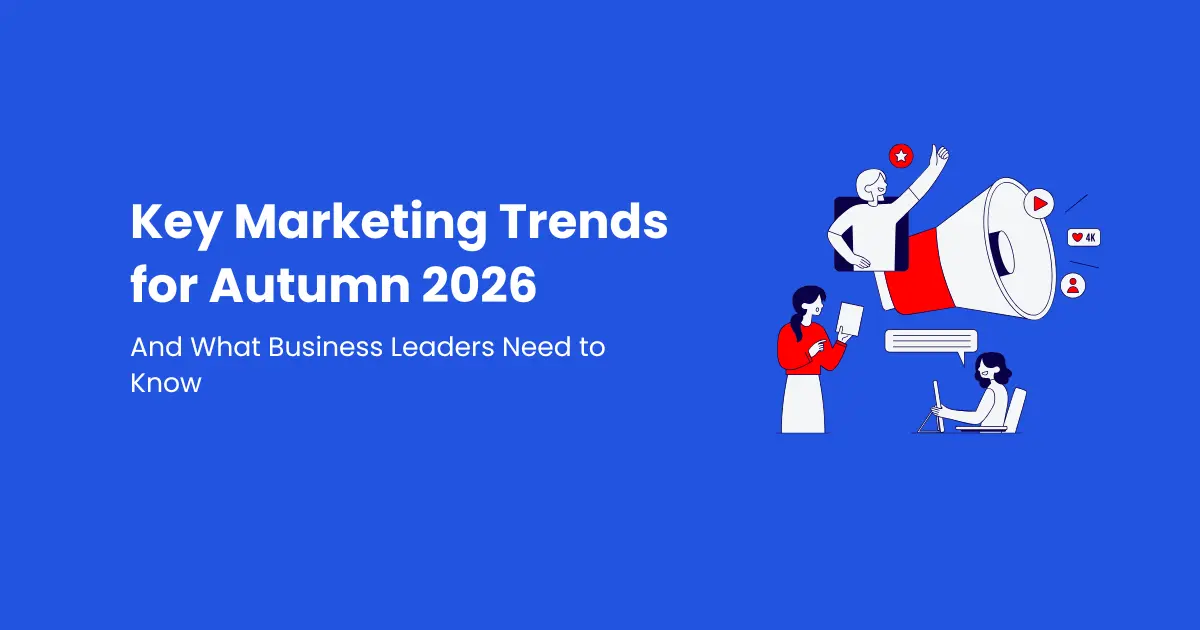
Key Marketing Trends for Autumn 2026

Just a few years ago, it was possible to plan a marketing strategy a year in advance without expecting any major changes. Today, the situation is very different. Artificial intelligence is changing everyday work processes, search engines are evolving, privacy requirements are becoming stricter, and businesses expect increasingly precise measurement of marketing results. All of this means that marketing plans need to be reviewed much more frequently than before.
At the same time, the way businesses think about marketing itself is changing. Simply being visible online or generating as much traffic as possible is no longer enough. More and more companies evaluate marketing based on the impact it has on business growth — whether it helps attract higher-quality customers, increase revenue, use budgets more efficiently, and make data-driven decisions.
This does not mean that businesses need to be the first to try every new tool or trend. In most cases, the best results are achieved not by those who rush to react to every innovation, but by those who are able to identify what truly creates value for their business and consistently integrate it into their processes.
In this article, we review the most important marketing trends for autumn 2026 and what they mean in practice. We will discuss not only what is changing, but also what businesses should pay attention to when planning their strategic marketing activities for the upcoming quarter.
Show more +1. Artificial Intelligence — One of the Most Important Marketing Trends of Autumn 2026
Just a year or two ago, many companies experimented with artificial intelligence for individual tasks — generating copy, visuals, or ideas. Today, the situation is changing rapidly. AI is increasingly becoming not a standalone tool, but a natural part of everyday processes.
It is used to analyse audience behaviour, optimise advertising campaigns, plan content, work with CRM data, segment customers, create personalised communication, and automate routine tasks. In other words, artificial intelligence is gradually becoming part of almost every stage of marketing — from planning to performance analysis.
This is particularly important because marketing professionals today work with significantly larger volumes of data than they did just a few years ago. The more channels, campaigns, and customer data there are, the harder it becomes to analyse everything manually. This is where artificial intelligence can help identify patterns more quickly, support data-driven decision-making, and free up more time for strategic work.
However, the companies that benefit the most are not necessarily those using the largest number of AI tools. It is far more important to understand where in the process these tools genuinely create value. When artificial intelligence becomes a consistent part of everyday work rather than a one-off experiment, teams can operate more efficiently, respond to changes faster, and devote more attention to what technology still cannot replace — strategy, creativity, and business decision-making.
2. AEO and GEO Remain Important
In recent years, we have repeatedly heard that the way people search for information and the way search engines provide answers are changing. While most searches previously started in the Google search bar, today more and more users are asking questions directly to artificial intelligence tools such as ChatGPT, Google AI Overviews, Claude, Gemini, and other generative AI search solutions.
Today, instead of dozens of links, users expect to receive a clear answer immediately. This is precisely why AEO (Answer Engine Optimization) and GEO (Generative Engine Optimization) are being discussed more frequently. These concepts describe the optimisation of content not only for traditional search, but also for artificial intelligence systems that process information themselves and generate answers for users.
However, it is important to understand that AEO and GEO do not replace SEO. On the contrary, they are becoming a natural extension of it. Strong technical SEO, a clear website structure, authoritative content, and a good user experience remain the foundation for both traditional search and artificial intelligence models.
In practice, this means that simply appearing on the first page of Google search results is no longer enough. It is becoming increasingly important to consider whether artificial intelligence systems understand and trust your content. Can they include your company in the answers they provide? Do they recommend your products, services, or expert insights when a user is looking for a solution?
Keywords alone are not enough to achieve this. Content needs to be clearly structured, trustworthy, and genuinely valuable, supported by expert knowledge, experience, and reliable sources. The more original insights, real-world examples, and practical experience you provide, the greater the likelihood that your content will not only be visible in traditional search but also become part of the answers generated by artificial intelligence systems.
Therefore, when planning a content strategy, it is worth thinking beyond rankings in Google search. Today, the main goal is to create content that is useful to people while also being understandable to both search engines and artificial intelligence models.
For those who would like to explore this topic in greater depth, we recommend reading: GEO vs. SEO: differences, key features, and everything business leaders should know
3. Quality Will Continue to Win Over Quantity
Artificial intelligence makes it possible to create content faster than ever before. In just a few minutes, it is possible to generate an article, a social media post, or a newsletter, which means that enormous amounts of new content appear online every day. At the same time, however, another problem is emerging — more and more of this content is becoming increasingly similar.
Consumers today have far more choice than they did just a few years ago. They quickly recognise superficial, generic information and look for content that genuinely helps them make a decision. Search engines and artificial intelligence models are also becoming increasingly capable of recognising this. As a result, simply publishing new articles or social media posts on a regular basis is no longer enough.
This autumn, the most important question is not how much content you create. What matters far more is whether it answers real customer questions, helps solve problems, provides useful insights, and demonstrates your expertise.
The content that creates the greatest value today is based on things that artificial intelligence cannot create on its own:
- expert insights;
- real client cases;
- research and data;
- practical experience from your team or company;
- original opinions and a clear point of view.
This is the type of content that builds trust. It not only helps potential customers make decisions but also strengthens brand authority in the long term. This is particularly important today, as both search engines and artificial intelligence models increasingly focus on content quality, credibility, and the expertise of its authors.
This does not mean that artificial intelligence should not be used when creating content. On the contrary, it can significantly speed up many processes: helping generate ideas, develop article structures, conduct initial analysis, or prepare a first draft. However, the final value comes not from the tool itself, but from human experience, the ability to understand the business context, and the capacity to enrich content with insights that no algorithm can provide.
Therefore, when planning a content strategy, it is worth focusing not on the number of publications but on their usefulness. One high-quality article based on real experience and expert insights can, over time, generate more organic traffic, enquiries, and trust than dozens of superficial publications.
4. Personalisation in Marketing and the Importance of Accurate Data
Not long ago, personalisation often meant simply using the recipient’s name in a newsletter or showing a general offer based on age or gender. Today, consumer expectations have increased significantly. They expect companies to understand their needs, remember previous interactions, and provide a relevant offer at the right time and through the right channel.
This level of personalisation cannot be achieved without high-quality data. This is precisely why first-party data — information that a business collects directly from its customers and that does not depend on third-party cookies or other external sources — is becoming increasingly important. This can include purchase history, enquiries, website visits, newsletter subscriptions, loyalty programme data, or other information that helps businesses better understand customer needs and behaviour.
When this data is brought together into a unified system, significantly more opportunities become available. A CRM system makes it possible to see the entire customer journey — from the first website visit to a repeat purchase. This not only helps businesses create more targeted communication but also enables better audience segmentation, marketing automation, more effective advertising campaign planning, and data-driven decision-making.
This trend is becoming even more important due to stricter privacy requirements and the move away from third-party cookies. Businesses can rely less and less on external data, which means that what they know about their own customers is becoming an increasingly important competitive advantage.
The higher the quality of your data, the more precise your communication can be. This means not only more relevant offers for customers but also more efficient use of advertising budgets, more accurate performance measurement, and a higher return on investment.
Therefore, today it is worth investing not only in new advertising channels or artificial intelligence tools. It is equally important to ensure that your data is accurate, well organised, and easy to use in practice. This data is becoming the foundation for both personalised communication and effective marketing in the future.
We also recommend reading our article: CRM Data Integration in Marketing: A Way to Make Lead-Based Advertising More Effective
5. Marketing Is Measured by Overall Business Growth Metrics
For a long time, the success of marketing campaigns was evaluated using metrics such as clicks, impressions, views, or follower counts. While this data still helps businesses understand how individual campaigns are performing, it rarely answers the most important business question — whether marketing is contributing to company growth.
This is precisely why the way marketing effectiveness is evaluated has been changing in recent years. For executives and business owners, it is no longer enough to know how many people saw an advertisement or visited a website. What matters much more is understanding how many of those people became customers, how much revenue they generated, whether they returned for another purchase, and what value they created for the business over the long term.
For this reason, increasing attention is being paid to business metrics that make it possible to objectively evaluate the value of marketing investments:
- customer acquisition cost (CAC);
- customer lifetime value (LTV);
- return on ad spend (ROAS);
- profitability;
- sales growth.
However, simply tracking these metrics is not enough. It is important to understand how they relate to one another and what decisions they can help businesses make. For example, a lower customer acquisition cost does not always mean a better result. In some cases, it may be worth investing more in acquiring a customer if that customer generates greater long-term value and becomes a loyal buyer.
High-quality data collection and measurement are therefore playing an increasingly important role. CRM systems, analytics tools, and advanced measurement solutions make it possible to connect marketing activities with actual sales and see the entire customer journey — from the first interaction to a completed transaction or repeat purchase.
This shift is also changing the role of marketing within organisations. Marketing is no longer a separate department whose goal is simply to generate as much traffic or as many enquiries as possible. Today, marketing is becoming one of the key business growth functions, working closely with sales, customer service, and company leadership.
Therefore, when planning marketing activities for autumn 2026, it is worth asking not only how many clicks or views your campaigns will generate. A much more important question is what real impact they will have on your business results.
6. Video Content Remains One of the Most Effective Formats
Short-form video has long since moved beyond being merely a social media trend. Today, it has become one of the most effective ways to reach audiences, present products, share expert knowledge, and build relationships with potential customers. Platforms such as Instagram Reels, TikTok, YouTube Shorts, and even LinkedIn are placing increasing emphasis on video content, making it an important part of business communication.
At the same time, the video content creation process itself is changing. Artificial intelligence solutions make it possible to generate scripts, create subtitles, edit videos, generate visuals, and even produce short advertising clips more quickly. This means that professional-looking video content is becoming accessible not only to large brands but also to smaller businesses that previously lacked the time or budget to create it.
However, technology alone does not guarantee results. Since almost anyone can now create a high-quality video, competitive advantage increasingly lies not in technical execution but in the content itself. Viewers quickly decide what is useful to them, which means that clear messaging, a relevant topic, and genuine value matter more than attractive effects or complex editing.
The first few seconds of a video are becoming particularly important. They often determine whether someone stops to keep watching or simply scrolls past. It is therefore worth answering as quickly as possible why the content is useful, what problem it will help solve, or what value it will provide to the viewer.
The purpose of video content is also evolving. It is increasingly being used not only to increase brand awareness but throughout the entire customer journey — from the first interaction with a brand to product presentation, customer education, trust-building, and even sales generation. Therefore, when planning a content strategy, it is worth thinking beyond individual videos and considering how video can contribute to broader business objectives.
Technology makes it possible to create video content faster than ever before, but the most important principle remains the same — people do not watch a video because it was created using the latest tools. They watch because it provides useful information, tells an interesting story, or offers a solution to their problem.
7. Automation Covers the Entire Customer Journey
Not long ago, automation for many businesses meant a few automated emails after registration or a reminder about an abandoned shopping cart. Today, the possibilities of automation are significantly broader. They cover the entire customer journey — from the first interaction with a brand to repeat purchases, strengthening loyalty, and building long-term relationships.
Almost every stage of customer interaction can be automated: activating advertising campaigns based on user behaviour, qualifying leads, creating newsletter sequences, delivering personalised offers, sending reminders, managing repeat-purchase communication, supporting customer service processes, or running loyalty programmes. The better these processes are connected, the more seamless the customer experience becomes.
The greatest value of automation is not simply the time it saves teams. It helps ensure that every customer receives relevant information at the right time, regardless of whether a specific employee is actively working with them at that moment. This reduces the likelihood of human error, enables faster responses to customer actions, and ensures consistent communication across all touchpoints.
Automation also makes it possible to use the elements discussed earlier more effectively — high-quality first-party data, CRM systems, artificial intelligence solutions, and personalised communication. Each of these can provide value independently, but the greatest results are achieved when they work together as a single system.
However, it is important to remember that not everything should be automated. Before implementing new solutions, businesses should first evaluate the processes themselves. If an inefficient process is simply automated, it will not become more effective — it will merely repeat the same mistakes faster. Successful automation therefore always starts with a clearly defined customer journey, high-quality data, and well-designed processes.
In 2026, automation is no longer a competitive advantage — in many areas, it is becoming a necessity. The question today is no longer whether processes should be automated. What matters much more is understanding at which stages of the customer journey automation can create the greatest value for both the business and the customer.
What Matters Most Is Not the Trends Themselves, but the Ability to Select and Apply Them
Every year, new technologies, platforms, and buzzwords emerge in the marketing world. Some trends take hold and become an integral part of everyday work, while others remain short-lived innovations. That is why the most important thing today is not trying to keep up with every change, but understanding which ones can genuinely create value for your business.
The trends of autumn 2026 clearly point in one direction — competitive advantage is created not by individual tools, but by a consistently functioning marketing system. Artificial intelligence, high-quality content, first-party data, CRM, automation, and accurate performance measurement are not separate initiatives. They deliver the greatest results when they work together and help businesses make better decisions.
Therefore, when planning activities for the coming months, it is worth not only following the latest marketing trends but also critically evaluating your current situation. Do you have high-quality data? Does your content strategy create real value? Does automation genuinely make your processes easier? Do you evaluate marketing results based on their impact on the business rather than simply on clicks or views?
There is no need to implement every change at once. It is far more important to identify those that can have the greatest impact on your business today and integrate them consistently into your everyday processes.
Technology and marketing channels will continue to evolve in the future. However, businesses that are able to identify the most important changes, apply them to their operations, and base their decisions on data will maintain a competitive advantage regardless of what trends emerge next year.
FAQ
Will Artificial Intelligence Replace Marketing Professionals?
No. Artificial intelligence can automate repetitive tasks, analyse data, or assist with content creation, but strategic decision-making, creativity, and an understanding of business context remain human responsibilities. The companies that benefit the most are those that use AI as an assistant rather than as a replacement for people.
What Is the Difference Between SEO, AEO, and GEO?
SEO focuses on visibility in traditional search engines such as Google. AEO (Answer Engine Optimization) helps content become part of the answers provided by answer engines, while GEO (Generative Engine Optimization) focuses on visibility in AI-generated responses. Today, the most effective strategy is to combine all three approaches.
Is It Still Worth Investing in SEO?
Yes. SEO remains one of the most important digital marketing channels. However, technical optimisation or keywords alone are no longer enough. It is important to create high-quality, expert, and clearly structured content that is useful to people, search engines, and artificial intelligence models alike.
Why Is First-Party Data Becoming So Important?
The importance of third-party cookies is declining, which makes it increasingly important for companies to rely on data they collect directly from their customers. High-quality first-party data enables more precise audience segmentation, personalised communication, more effective advertising campaign management, and more accurate performance measurement.
Which Marketing Metrics Are the Most Important to Track Today?
In addition to advertising clicks or impressions, increasing attention is being paid to business metrics such as customer acquisition cost (CAC), customer lifetime value (LTV), return on ad spend (ROAS), profitability, and sales growth. These metrics provide the clearest indication of marketing’s real impact on the business.
Where Should a Business Start With Marketing Automation?
The first step should be to evaluate the customer journey and existing processes. Only then should automation solutions be implemented. Automating inefficient processes does not eliminate problems — it simply makes them happen faster. Successful automation therefore starts with a clear strategy, high-quality data, and a properly functioning CRM system.
Which 2026 Marketing Trend Should Businesses Focus on the Most?
There is no single universal answer. For some companies, integrating artificial intelligence will create the greatest value; for others, the priority may be higher-quality first-party data, CRM, automation, or content strategy. The most important thing is not to try to implement every trend at once, but to identify those that will contribute most directly to your business objectives.